What Is NAD+ in Skincare? An Honest Look at the Science
What NAD+ is, why levels appear to drop with age, and what research on NAD+ applied to skin does and does not show yet, explained plainly with sources.
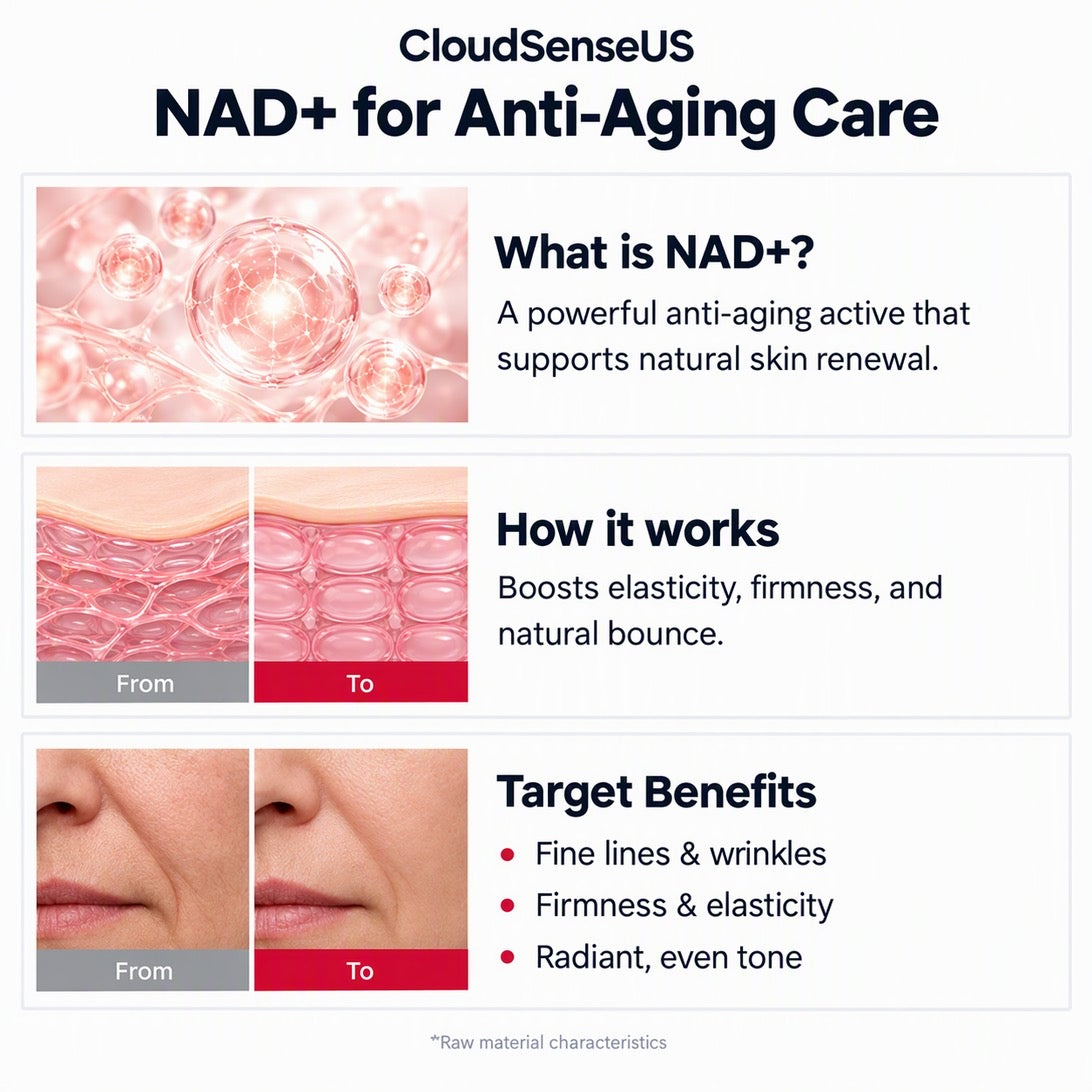
NAD+ has moved from the supplement aisle to the serum shelf in what feels like a single year. If you have seen it on a label and wondered whether it is real science or the newest buzzword, the honest answer is: a little of both, and the details matter.
What is NAD+?
NAD+ stands for nicotinamide adenine dinucleotide. It is a coenzyme found in every living cell, and cells rely on it to turn the food you eat into energy they can use.
In biochemistry terms, NAD+ carries electrons in the redox reactions that power metabolism. It is also used by enzyme families called sirtuins and PARPs, which modify DNA, RNA and proteins after they are made. That double role is why longevity researchers pay so much attention to it.
Put simply, NAD+ is part of the machinery that keeps cells running. It is not a moisturizer and it is not a filler. It is a molecule with a job inside the cell.
Does NAD+ decline with age?
This is the line you will find on almost every NAD+ product, so it is worth being precise. In animal studies, NAD+ levels drop with age in a range of tissues, including muscle, fat, brain, liver and skin, according to a 2020 review in Signal Transduction and Targeted Therapy.
In humans, the picture is less tidy. A 2021 review in Nutrients concluded that the decline is tissue-dependent rather than universal. Skeletal muscle shows a fairly consistent drop, while other tissues show mixed results or no clear change.
Skin is one place where a human study did find lower NAD+ in older samples, but the reviewers point out how limited that data is. So the fair summary is: NAD+ appears to decline with age in many tissues, with an asterisk on how, where and how much.

Can skin absorb topical NAD+?
Here is where honesty matters most. NAD+ is a fairly large, water-loving molecule, and getting any active ingredient through the skin barrier is the hardest part of skincare.
Research on NAD+ applied to skin is early. A 2025 lab study in Current Issues in Molecular Biology tested NAD+ on skin cells and on samples of donated human skin. A liposomal form of NAD+, wrapped in tiny fat-based bubbles, moved further into the skin samples than plain NAD+ and lowered markers of cell aging in the dish.
That is encouraging, but it is lab work: cell cultures and skin samples, not people using a serum at home for months. The authors themselves list the lack of real-world, in-body confirmation as a limitation.
What the evidence does not show yet
- There are no large, long-term studies showing that NAD+ alone, applied to the face, reshapes skin.
- Results from a petri dish do not automatically show up in the mirror.
- NAD+ supplements you swallow and NAD+ you apply to skin are different forms. Findings from one do not transfer to the other.
If a label promises that NAD+ in a bottle will turn back the clock, that is marketing talking, not science. A good NAD+ serum should be honest about what each ingredient brings.
Buy 1, Get 1 FREE when you subscribe — your first order ships two bottles of CloudSense NAD Serum for the price of one.
Shop CloudSense NAD Serum →NAD+ vs niacinamide: what is the difference?
Niacinamide is a form of vitamin B3, and it is one of the building blocks the body uses to make NAD+. It is a familiar, well-studied skincare ingredient in its own right.
NAD+ is the finished coenzyme. Putting it straight into a serum is a newer idea, part of the longevity trend that has traveled from wellness supplements into K-beauty-style formulas. The two are related, not interchangeable.
So why choose an NAD+ serum at all?
Because a good serum is never one ingredient. CloudSense NAD Serum pairs NAD+ with EGF, low-molecular collagen and 8 peptides. Together they are chosen to support the look of firmness, elasticity and smoother fine lines, while collagen adds the hydrated, plump feel you notice as soon as it sinks in.
Texture matters too. It is a lightweight red serum in a 30 ml glass dropper bottle that absorbs fast and never feels sticky, so it layers easily under moisturizer and SPF. It is non-comedogenic tested, with no artificial colors or fragrance.
Think of NAD+ as the forward-looking part of the formula: the ingredient with the most interesting research still ahead of it, sitting next to ingredients that deliver the daily look and feel of softer, more radiant skin.

How to use an NAD serum
- Cleanse, then apply your toner.
- Place 2 to 4 drops in your palm or fingertips.
- Press into your face and neck instead of rubbing hard.
- Use morning and night, then follow with moisturizer.
- In the morning, finish with a broad-spectrum sunscreen.
NAD+ serum FAQ
Does topical NAD+ work?
Research on NAD+ applied to skin is early and mostly lab-based. What you can expect from CloudSense NAD Serum comes from the full formula: a hydrated, smoother feel right away and a gradual, cosmetic improvement in how firm and even your skin looks with consistent use.
Is NAD+ the same as NMN or NR?
No. NMN and NR are precursors, the raw materials the body can convert into NAD+, and they are usually sold as supplements. This serum contains NAD+ itself, applied to skin.
Can I use NAD serum with vitamin C or retinol?
Many people do. Add one new product at a time, patch test each one, and if your skin feels irritated, space them out, for example the serum in the morning and retinol at night.
Is NAD serum good for sensitive skin?
The formula is non-comedogenic tested and has no artificial colors or fragrance. Every skin is different, so patch test 24 hours before your first full use.
The science on NAD+ in skincare is still being written, and anyone who tells you otherwise is overselling. What you can judge today is how your skin looks and feels with a consistent routine. Your first order comes with a 100-day money-back guarantee, and free US shipping on orders of $50 or more.
Buy 1, Get 1 FREE on your first subscription order. Refills ship at the regular subscription price, and you can skip, change or cancel anytime.
Try CloudSense NAD Serum →Sources: Xie et al., NAD+ metabolism: pathophysiologic mechanisms and therapeutic potential, Signal Transduction and Targeted Therapy (2020); Peluso et al., Age-Dependent Decline of NAD+: Universal Truth or Confounded Consensus?, Nutrients (2021); Ministrini et al., A Liposomal Formulation Enhances the Anti-Senescence Properties of NAD+ in Endothelial Cells and Keratinocytes, Current Issues in Molecular Biology (2025)
 NAD+, EGF, Collagen and Peptides: A Stack for Firmer-Looking Skin
 Neck, Smile and Forehead Lines: A Daily Firming Serum Routine
 How to Layer a Serum: The Right Skincare Order, Step by Step